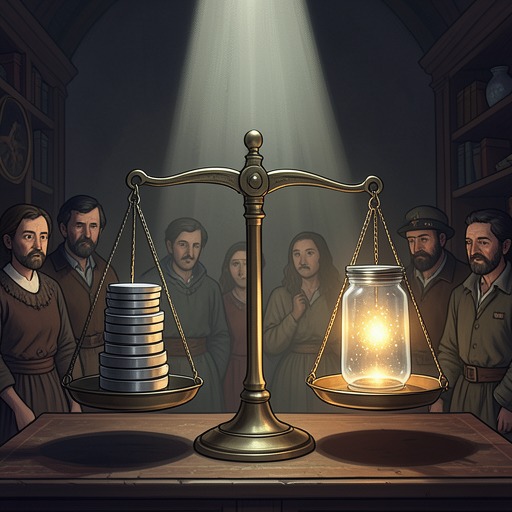
Revolt, freedom, and passion
The Myth of SisyphusRevolt, freedom, and passion are presented as the three consequences of the absurd and as the governing rule of life for the Absurd Man. They do not promise reconciliation with the world or offer a final doctrine; they describe how consciousness can transform an anguished recognition of the inhuman into a refusal of suicide and an intensified participation in earthly life.
Definition and Starting Point
The rule begins with consciousness. The absurd exposes a conflict between the human demand for meaning and a world that does not answer that demand, but the recognition of this conflict is not itself a conclusion. By the mere activity of consciousness, the Absurd Man turns what first appeared as an invitation to death into a principle for living. The decisive movement is therefore negative and affirmative at once: he refuses suicide, yet refuses as well the consoling belief that the paradox has been solved.
This position also rejects the idea that the present is merely a provisional stage on the way to another world. The succession of presents before a constantly conscious soul becomes the proper field of absurd existence. The language of an ideal is deliberately distrusted, because revolt, freedom, and passion are not a fixed perfection or a supernatural vocation. They are consequences reached by reasoning and sustained in the pressure of lived experience.
Revolt and Lucid Despair
Revolt is the first consequence because the absurd is not overcome by a leap into an imagined resolution. The mind must meet the night, but the relevant night is not a darkness deliberately produced by closed eyes or by an act of will that seeks refuge in obscurity. It is the lucid despair of a vigil of the mind: a condition in which the contradiction remains visible and intelligence continues to outline the world rather than abolishing it.
This distinction separates revolt from evasion. Mystical or existential leaps may appear to solve the paradox, but to the conscious spectator they remain absurd because, in claiming to resolve the contradiction, they reinstate it intact. The leap therefore becomes one human attitude among others, not an escape from judgment. The absurd world returns in its splendor and diversity precisely when consciousness refuses to mistake passionate understanding for a final answer.
The rule also requires resistance to intellectual closure. It is bad to stop and hard to be satisfied with a single way of seeing; contradiction is described as one of the most subtle spiritual forces. Yet the discussion does not remain a theory of thought. Its pressure falls on conduct: the preceding argument defines a way of thinking, but the point is to live. Revolt is thus sustained attention to the unresolved world, not a temporary gesture of defiance.
Freedom and Passionate Living
Freedom follows from the collapse of external guarantees. Once no final appeal can be secured beyond the world, the individual is no longer bound to organize life around a promised culmination. This freedom is not arbitrary license. It is the burden of judging oneself, an act for which the human being alone is responsible. The absence of a transcendent solution increases rather than removes the demand for conscious choice.
Passion gives this freedom its force. The Absurd Man is directed toward the present and toward the succession of presents, not toward an imagined eternity that would make earthly feeling secondary. The Greeks’ claim that those who died young were beloved of the gods is treated ironically: entering the divine world would mean losing the purest joy, the capacity to feel on this earth. Passion therefore means attachment to lived experience in its finite, unredeemed form.
The three consequences form a single discipline. Revolt preserves the contradiction, freedom accepts the consequences of having no final appeal, and passion fills the available present with the greatest possible intensity. Together they constitute an ethics of consciousness rather than a code that promises salvation. Their difficulty is double: obeying the flame is called both the easiest and the hardest thing to do.
Concrete Figures of Absurd Existence
The logic of this rule can be seen in the treatment of Joseph K. in The Trial. Joseph K. is accused without learning of what, wishes to defend himself without knowing the grounds of the charge, and encounters lawyers who find his case difficult. He continues to love, eat, and read his paper while the process advances around him. When he is judged, the courtroom is very dark; he barely understands the proceedings and only assumes that he is condemned.
The final movement makes institutional power brutally concrete. Two well-dressed, polite gentlemen come for Joseph K., lead him courteously to a wretched suburb, place his head on a stone, and slit his throat. His last words, “Like a dog,” reduce the entire machinery of accusation and judgment to the degradation it has produced. The episode shows a life subjected to unexplained authority while ordinary habits continue almost undisturbed. Its absurdity lies not only in the violence, but in the character’s insufficient astonishment at the naturalness of what happens to him.
This naturalness is part of the rule’s literary significance. Kafka’s work forces rereading because its endings, or its absence of endings, suggest explanations without stating them plainly. The story’s external simplicity allows extraordinary events to appear ordinary to the character, while the mind projects its spiritual tragedy into concrete gestures and institutions. Revolt, freedom, and passion thus stand against a form of existence in which the person continues living inside condemnation without fully confronting the contradiction.
From Personal Consciousness to Historical Action
The rule also governs the movement from individual absurdity toward history. At Tipasa, the remembered freedom of youth confronts a landscape altered by war, tyranny, police forces, and barbed wire. The ruins that once offered open movement can now be entered only through certain openings; walking there at night is forbidden, and an official guardian is present by day. The restriction of the physical site becomes an image of a wider historical enclosure.
The change is dated to September 2, 1939, when the expected journey to Greece was interrupted because war came instead and later spread to Greece. The distance between the warm ruins and their barbed wire has become an inward distance as well. A person originally raised amid beauty and plenty now finds that beauty reduced to memory, while empires fall, nations and people turn against one another, and innocence gives way to unintended guilt. The attempt to recover a former lift therefore becomes an encounter with the loss of innocence rather than a return to it.
In this historical setting, revolt cannot mean private purity or withdrawal. The artist rejects the comfortable role of detached witness because contemporary tyrannies no longer permit silence or neutrality; one must stand either for or against, and his stated position is against. He also refuses the idea that a future end of history can justify present oppression. Intellectuals who defend certain oppressions in the name of history create privileged executioners, whereas the traditional left’s opposition to injustice, obscurantism, and oppression requires rejecting all such exemptions.
The same principle shapes the artist’s relation to creation. Art must serve suffering and beauty simultaneously rather than retreating either into an ivory tower or into a social church. The era of the chairbound artist is over, but danger must be accepted without surrendering to bitterness. The artist stands among those who work and struggle, neither above nor below them; in the face of oppression, the vocation of art is to open prisons and give voice to the sorrows and joys of all.
Significance and Consequences
Revolt, freedom, and passion therefore connect metaphysical lucidity with ethical and political conduct. They refuse suicide, consoling leaps, historical justifications for violence, artistic isolation, and the reduction of creation to either beauty without suffering or humanity without form. The rule does not erase contradiction; it makes contradiction the condition under which action must continue.
Its final consequence is collective as well as individual. Art alone may not produce the renewal implied by justice and liberty, but without art that renewal would have no forms and would consequently be nothing. Culture, together with the relative freedom it implies, prevents even a supposedly perfect society from becoming a jungle. Authentic creation becomes a gift to the future because it preserves the human capacity to feel, judge, resist, and remain passionately present without appeal.